
Tabletop Menu-Board SoC and Thermal Budget: Matching Open-Frame Compute to Ceiling-Mount Heat
For a QSR deployment, the tabletop menu-board SoC and thermal budget you size for a counter unit must also survive the heat jacket of a ceiling-mounted overhead display in the same footprint. Indoor ceiling-mount environments run cooler than outdoor solar-load cases, but heat rises and traps above the counter, so the open-frame compute card you place in the tabletop base needs a different thermal envelope than a ceiling box. This guide walks a real open-frame spec sheet and gives a decision rule for matching compute placement to mounting position.
Where the Tabletop Thermal Budget Differs from the Ceiling Board
QSR menu boards split into two form factors with different thermal physics: a tabletop unit (a self-service ordering or counter display) and a ceiling-mounted overhead board behind the counter. The tabletop thermal budget is generous because the base vents to the front-facing side and sits in open air. The ceiling board sheds heat upward, where it builds above the counterline, so its budget is tighter. [1]. Matching the digital menu board thermal management QSR to the actual ceiling mount vs tabletop digital signage thermal profile is the first sizing step, not an afterthought.
Teams comparing implementation options can also consult About Wintouch, Touchscreen Manufacturer in China · Wintouch.
The Open-Frame SoC That Drives the Tabletop Unit
The open-frame compute in a typical tabletop menu board is a low-power quad-core system-on-chip. As a published reference example, a 23.8-inch tabletop unit carries a quad-core A53 CPU with a Mali-T450 GPU (XM.H351 chipset), 1GB+8GB memory and storage, and a DC12V power input ([3]). SoC compute for a digital menu board only needs to render static and lightly animated menu content — no heavy 3D or video pipelines — so a quad-core A53 with an entry Mali GPU is more than adequate and keeps the thermal envelope small.
Why These Units Are Designed Fanless
Menu boards are fanless because the counterline environment is dusty, humid, and food-contaminated; moving air would pull grease and debris onto the board ([2] discusses fanless boards as a QSR differentiator). Passive conduction through a heat sink and a sheet-metal chassis removes heat with no fans, which also kills audible noise in a customer-facing space. This fanless digital menu board heat dissipation approach is why a tabletop unit can run its compute for hours without a moving part, and it sets the cooling constraint the thermal budget must respect.
Reading Power Consumption and the Thermal Budget
Power and heat are the same budget: every watt drawn becomes heat that the fanless enclosure must shed. The reference tabletop board lists an overall power consumption of 35W (max) and a standby draw below 1W ([3]).
| Spec | Value |
|---|---|
| CPU | Quad-core A53 |
| GPU | Multi-core Mali-T450 |
| Memory/Storage | 1GB + 8GB |
| Power input | DC12V |
| Overall consumption | 35W (max) |
| Standby | <1W |
That sub-1W standby is the number that dominates tabletop digital menu board power consumption across a fleet: a restaurant with dozens of units left in low-power mode overnight spends more on idle draw than on peak menu rendering, so standby efficiency is where the thermal and power budget is won.
Operating Temperature Envelope: What ‘Thermal Budget’ Really Sets
Operating temperature is a spec limit, not a test-to-fail number — it is the ceiling the manufacturer guarantees the board keeps working under. Most outdoor digital menu board units are rated to an operational temperature of 50C or lower, and only some match higher ratings, with one vendor’s unit rated to 60C in direct solar load ([2]). An indoor ceiling-mount position rarely approaches that solar-load case, so the thermal budget is comfortable — but only if the compute is placed where it can dissipate the 35W envelope it draws.
Mounting Changes the Heat Path: Ceiling vs. Wall vs. Counter
The mounting position changes where heat can escape. A ceiling board radiates upward and traps heat against the suspended structure above the counter; a wall board sheds rear heat into the open wall cavity; a tabletop unit vents to its front-facing side ([1]). Because an open-frame compute card in the tabletop base gets front ventilation, it is dimensioned differently from a ceiling box that must conduct heat through its rear mount — see the site’s guidance on open-frame panel PC connectivity and mounting and open-frame vs. wall-mounted signage for restaurant kiosks for the form-factor trade-offs.
Calibrating Brightness for Indoor vs. Outdoor Positions
Brightness is a separate calibration axis from heat. Indoor counter and ceiling boards need 350–500 nits, which is visible without being harsh in a lit ordering area, while outdoor or drive-thru displays require weatherproofing, anti-glare, and at least 1000+ nits to stay clear in direct sunlight ([4]). Indoor menu-board brightness at 350–500 nits and outdoor brightness at 1000+ nits sit on opposite ends, so an indoor 700-nits reference board such as the tabletop example above already exceeds the indoor floor and trades some efficiency for headroom.
Decision Rule: Matching Compute Placement to Mounting Position
Use this checklist when sizing open-frame compute against your QSR mounting mix:
For a practical vendor example, readers can review Outdoor LED Displays for Transit & Smart City Projects · Wintouch.
- Compute duty — confirm a quad-core A53-class SoC is enough for your static-to-dynamic menu content before spending thermal budget on a bigger chip.
- Enclosure and airflow direction — place compute where its enclosure can shed heat: tabletop vent to the front, ceiling box conduct through the rear mount.
- Operating-temperature margin — verify the newest, hottest month in the location stays comfortably under the unit’s rated envelope.
- Standby power per unit — multiply the sub-1W standby figure by the fleet count and idle hours; the fleet idle draw usually outweighs peak rendering.
- Nits for the light level — use 350–500 nits indoors and 1000+ nits for outdoor or drive-thru positions.
This is engineering guidance for integrators, drawn from the cited public specs and vendor guides above; final qualification still requires testing your exact SKU in its environment — do not treat any temperature or power figure as a guarantee for a board you did not source. For the compute side, see the site’s brief on compute and connectivity contracts for data and open-frame vs. fully-enclosed panel PCs for kiosks.
Related guides
- Open Frame Panel PC Connectivity and: RS-232, USB and Power Contracts for Embedded Kiosks
- Open-Frame vs Laminated Wall-Mounted Signage for Restaurant Kiosks: A Panel-Bonding ROI Comparison
- Compute and Connectivity Contracts for Data: An Integrator’s Checklist
- Open-Frame vs Fully-Enclosed Panel PC for Embedded Kiosks
Content reviewed: 2026-08-16.
Evidence confidence
Confidence: Medium. This rating reflects cross-checking 4 sources across 4 independent domains. It measures evidence coverage, not certainty; verify safety-critical work against manufacturer instructions and local requirements.
References
APA 7th edition
- ↑Cited 2 timesLsquared. (2024). Digital Menu Boards: The Ultimate Guide for QSRs and. https://lsquared.com/digital-signage-insights/digital-menu-boards-the-ultimate-guide-for-qsrs-and-fast-casual-restaurants.
- ↑Cited 2 timesKioskindustry. (n.d.). QSR Digital Menu Boards: Indoor & Outdoor Technical Guide. Retrieved August 16, 2026, from https://kioskindustry.org/digital-menu-board-technical-considerations.
- ↑Cited 2 timesKontechdisplay. (n.d.). Tabletop Digital Menu Boards Display. Retrieved August 16, 2026, from https://kontechdisplay.com/product/digital-menu-board.
- ↑Agneovo. (n.d.). What Is A Digital Menu Board? A Beginner’s Guide For Small QSR Owners. Retrieved August 16, 2026, from https://www.agneovo.com/en_us/insight/what-is-a-digital-menu-board-a-beginners-guide-for-small-qsr-owners.
You should also read:
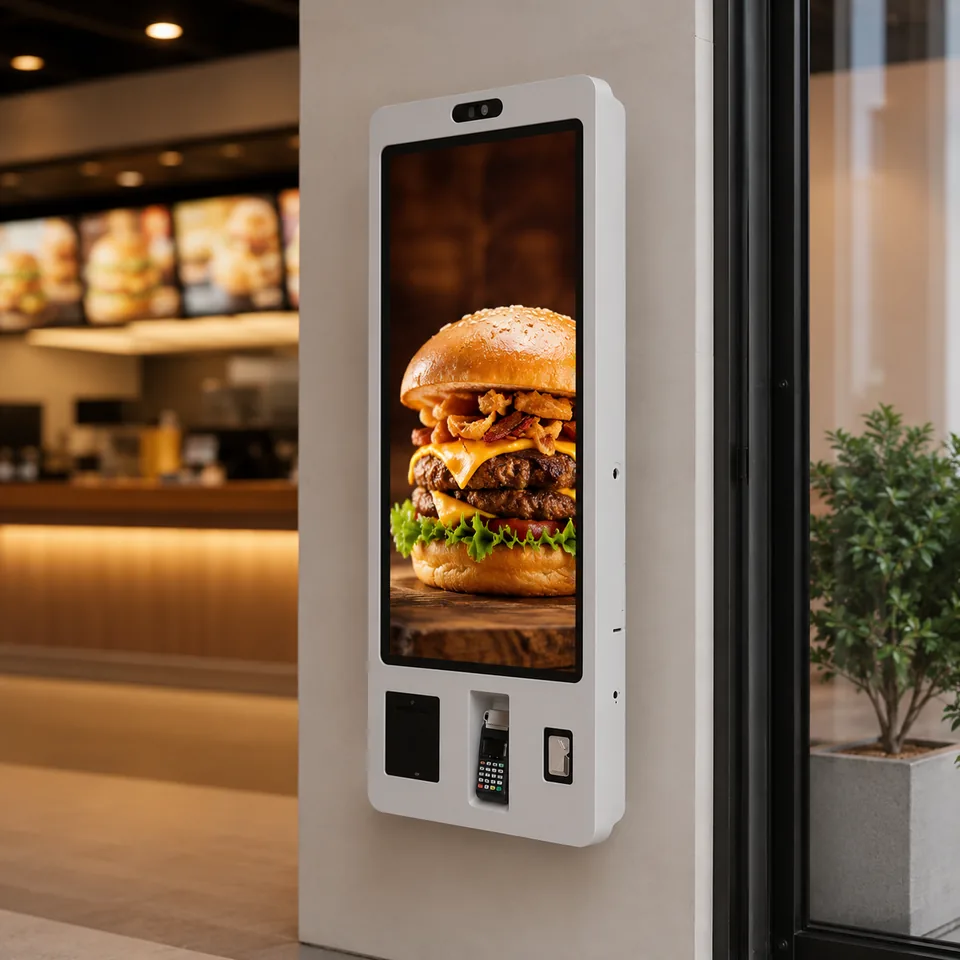
Open-Frame vs Laminated Wall-Mounted Signage for Restaurant Kiosks: A Panel-Bonding ROI Comparison
The Spec Fork Every Integrator Meets on a QSR Wall Building a restaurant wall terminal comes down to one decision: do you source an open-frame touch panel and own the enclosure, bezel, and bonding yourself, or buy a fully laminated, ultra-narrow-bezel unit delivered as a…
Continue reading...
Edge AI on-device inference guide: The Compute & Connectivity Contract for 2026
What on-device inference changes about your data-supply contract On-device inference runs the AI model on the node’s own NPU rather than shipping data to a cloud round-trip. For 2026 fleets, that is not a hardware swap — it is a rebase of your data-supply contract:…
Continue reading...
Compute and Connectivity Contracts for Data: An Integrator's Checklist
What changes in the integrator’s BoM when content goes live Compute and connectivity contracts for data change what an integrator stocks the moment content stops being a pre-cached loop and becomes live, input-driven material tied to location, time and behaviour. Data-driven digital signage 2026 trends…
Continue reading...